If It's For Sale, It Can't Be Bad — Right? Presenting The Magic Shelf.
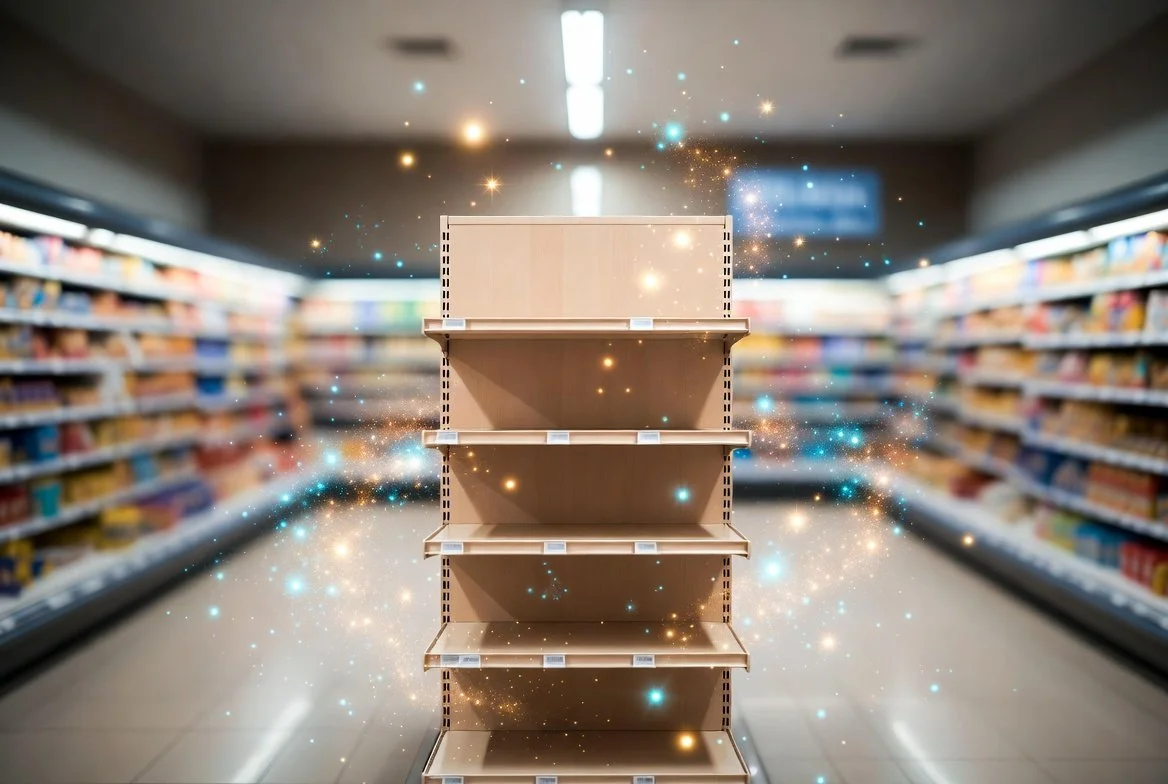
If it’s on a shelf in a store, it can’t be bad, right?
This central tenet of consumerism might just be one of the most destructive forces in the history of the world: the assumption that just because something is being sold, it should be bought, regardless of the consequences. I call this phenomenon The Magic Shelf, and whether you let it control you has implications for all of us.
Let’s say there’s something you want to buy, though you’ve heard that it might hasten climate change. But if it did, surely someone would do something about it and it wouldn’t be sitting here for you to buy, in this store staffed by nice, sane people. Oh look, there’s a rustic font and some of the packaging is an earthy brown – clearly there’s no issue here. Let’s get it! That’s The Magic Shelf in action. Other disasters The Magic Shelf asks us not to think about include child labor, inequality, carcinogens, oceans full of single-use plastic…
Ripping on consumerism was counterculture gold for the last few decades of the 20th century, but I think we need to keep it up, now more than ever. Take a look at these words from MLK, in his 1967 speech “Beyond Vietnam: A Time to Break Silence”:
"When machines and computers, profit motives and property rights, are considered more important than people, the giant triplets of racism, extreme materialism, and militarism are incapable of being conquered."
Just in case you missed it, that’s Dr. King putting materialism – the twin on which consumerism depends – on the same short list as racism. And note how consumerism contrasts with the guidelines that Braiding Sweetgrass author Robin Wall Kimmerer calls “The Honorable Harvest,” which ask us to never take the first, never take the last, take only what we need, never take more than half, harvest in a way that minimizes harm, and give a gift in reciprocity for what we have taken. Can’t say that really applies to Big Gulps.
A bottle of water uses six times more water to manufacture than it contains, consumes the same amount of energy to produce as it takes to charge a smartphone 74 times, is used once and will then outlive you and your descendants. Not to mention the fossil fuel and packaging it takes to reach you. Really? That’s how we think this should go? Kind of makes you feel like we’ve got things backwards. But when we buy that bottle of water in anything besides an emergency scenario, we’re consenting to all of the above. Which is easy to do when it’s right there on The Magic Shelf.
As a child of the U.S. suburbs, it often felt like we all woke up one day in the consumerist world, with no memory of what came before. And, perceiving it as normal and seeing everyone else doing the same, we took our place at the register. In philosophy this is known as the problem of induction, also represented by the old joke about the guy falling from the top of a building and saying “So far, so good” as he passes each floor. We bought stuff, nothing bad appeared to happen, so we bought more stuff. All while large swaths of the world were being razed to feed our appetites.
How did The Magic Shelf come to be? Blame the industrial revolution, deliberate demand engineering, urban planning, planned obsolescence, growth imperative, and any of the other factors that have severed ties to what makes us human. The Magic Shelf is a memorial to the protective forces that might have prevented it: our seasonal rituals, sense of place, belonging, integration with the natural world, ancestral foods, spirituality, communal gathering, commons thinking – so much of it watered down if not eliminated. And in their place, (bum...) like the monolith of 2001: A Space Odyssey, (bum…) there’s (bum…) The Magic Shelf (bum-bum!).
For those who can afford it, the trend is more, more, more. In the U.S., on average, we now eat more calories (yet waste more food), own more cars, live in bigger houses (with fewer people), rent more storage units to put all the stuff that doesn’t fit in those houses, buy more electronics, and generate more e-waste than ever before. In my own lifetime, I’ve watched as consumption has multiplied like a Gremlin fed after midnight.
Take coffee: a thing once drunk from a small cup in a house or restaurant has now flooded every corner of every city, at all times of day, paraded about in gargantuan plastic vessels and topped with rainbow whipped cream. If you do make coffee at home, it’s now likely to pour forth from a waste-intensive apparatus like a Nespresso machine, which makes it oh so easy to have another and another. Or ice cream. When exactly did the kiddie size turn into four scoops? When it found The Magic Shelf of course (not to be confused with Magic Shell, which can be found on The Magic Shelf).
Speaking of new and growing appetites, take a look at AI. Here are some insights from the 2025 MIT Technology Review article “We did the math on AI’s energy footprint. Here’s the story you haven’t heard":
We’re on a path towards AI using as much electricity every year as 22% of all US households.
This is likely the smallest AI footprint we’ll ever have.
A 5-second video can use an equivalent amount of energy to riding 38 miles on an e-bike or running a microwave for 1 hour.
One person’s daily energy consumption from using AI can equal a 100 mile ride on that e-bike or running the microwave for 3.5 hours.
Funny, you don’t see numbers like those as often as you hear about all of the ways AI will make our lives easier. Maybe it will, but at what cost? The Magic Shelf permits you not to ask. (And whatever you cooked in that microwave? Don't eat it.)
One caveat: consumerism has a sneaky way of sometimes presenting the solution to the evils of consumerism as more consumerism. Don’t like what we’re selling? Make your voice heard by buying this other thing instead! Case in point: it was BP who popularized the term “carbon footprint” in the early 2000s, having gotten it from their ad agency; in 2004, they introduced a “carbon footprint calculator” to help consumers navigate their impact. The solution to the carbon footprint generated by BP? Turn to BP.
So there’s a duality I’m asking you to hold. On the one hand, individual consumer choices are nothing compared to the changes that are possible on a larger scale, as in policymaking decisions on the governmental or corporate level. That said, consumer choices also have very real effects. Whether companies need to change or we need to shop differently isn’t a binary – ideally we’re working both fronts.
The negative effects of unsustainable products are widespread and, frankly, devastating. But there’s an individual cost as well. What happens to each of us when we enter into the endless loop of consumption that we’re told we need to enact for all sorts of reasons? What if even some small part of us believes the commercials that suggests our life depends on buying the right kind of toothpaste? Smart as we are, we have to admit that being constantly barraged with advertising chips away at our resolve. After all, there’s a whole lot of money being spent on trying to get past our defenses, and the people who spend it intend to recoup their investment.
Psychologist Tim Kasser finds that "when people believe materialistic values are important, they report less happiness and more distress, have poorer interpersonal relationships, contribute less to the community, and engage in more ecologically damaging behaviors." He also reports that when wealth and possessions sit at the center of someone's values, costs include heightened anxiety, depression, weaker self-esteem, and difficulty forming close relationships.
Then there’s the “hedonic treadmill” concept put forth by the psychologists Philip Brickman and Donald T. Campbell, which describes the psychological mechanism in which acquiring a new possession produces a brief lift in mood that reliably fades, requiring the next acquisition in order to return to baseline. Hence the poor success rate for using consumption as a means of acquiring meaning or satisfaction.
As a coach, I often work with people who seek a greater sense of meaning in life. I believe the world abounds with meaning – I’ve found it in things as simple as making maple syrup. And so I ask you to see past the smoke and mirrors of The Magic Shelf, and to weigh the impact your purchasing power has not only on the world but also on the self. If you’re looking for antidotes, recall those missing guardrails – the seasonal rituals, sense of place, belonging, integration with the natural world, ancestral foods, spirituality, communal gathering, and commons thinking. Bring them back and The Magic Shelf loses all its magic.
